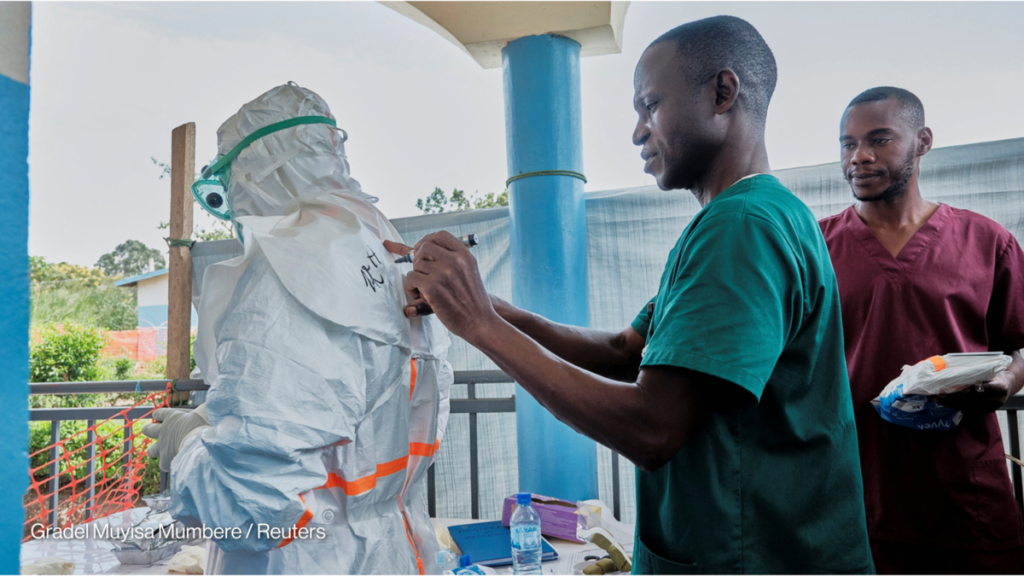
Photo: Gradel Muyisa Mumbere / Reuters
Ebola in Congo has passed a grim line. Government figures released on Thursday put confirmed cases at 12,021, with 5,904 deaths. Nearly half of everyone confirmed infected has died — and the fighting in the east is now getting in the way of the people trying to stop it. Here is what you need to know.
1. The toll: 12,021 cases, 5,904 deaths
The figures come from the Congolese government’s latest update, released on Thursday, 26 November. Of the 12,021 confirmed infections, 5,904 people have died. That is a fatality rate of about 49% — nearly one in two.
2. The second-largest outbreak ever — and the fastest-growing
This is now the second-largest Ebola outbreak on record, behind only the 2014–2016 West African outbreak. It is also the fastest-growing ever seen, and the deadliest of the 17 outbreaks Congo has recorded.
3. It could pass the deadliest outbreak on record
The 2014–2016 outbreak killed more than 11,000 people across Guinea, Liberia and Sierra Leone. At the current pace, Congo’s outbreak is on course to pass that toll.
4. This is the Bundibugyo strain — and there is no vaccine for it
The outbreak is caused by Bundibugyo, a rarer species of the Ebola virus. There is no approved vaccine and no approved treatment for it, which is one reason the response leans so heavily on finding cases early and isolating them.
5. It started in Ituri in May — and has reached 8 of 26 provinces
The outbreak was declared in mid-May in Ituri province, in the north-east. It has since spread to eight of Congo’s 26 provinces, with Ituri still the worst hit.
6. The numbers are climbing fast
On 16 November, the count stood at 11,376 cases and 5,568 deaths. Ten days later it was 12,021 cases and 5,904 deaths — 645 more infections and 336 more deaths in ten days.
7. The fighting is breaking the response
Fighting between the Congolese army and CRP rebels flared again on Thursday morning in Iga-Barrière, about 25 kilometres north of Bunia. Responders were forced to evacuate the area, and contact tracing — the work of finding everyone an infected person may have exposed — was disrupted.
8. Most new cases are appearing out of nowhere
A World Health Organization risk assessment published on 25 November found that more than 80% of newly reported infections are being detected outside known contact lists. In other words, the virus is moving faster than the people chasing it.
9. People do survive it
It is not a death sentence for everyone. The WHO’s daily figures recorded 3,307 recoveries as of 23 November — people who caught the virus and lived.
10. There is a plan — and Nigeria has been here before
The WHO and the Africa CDC have published an updated continental preparedness and response plan for the Bundibugyo virus, running from November 2026 to May 2027. And Nigeria knows this virus: the 2014 outbreak was stopped in Lagos, and that containment is still the reference point for how it is done. The question in Congo is whether the fighting will let the response work.
The outbreak is still growing, and the fighting is still in the way. The next update will tell us whether the response is catching up — or falling further behind.