FIFA has named the five people who will run Nigerian football. The world governing body sent a letter to the Nigeria Football Federation on Wednesday, naming a normalisation committee to take over the federation after its leadership resigned in August — and the best-known name on the list is a former Super Eagles star.
Here is why it happened, who they are, and why each of them was chosen.
Why FIFA stepped in
On Thursday 27 August 2026, NFF president Ibrahim Gusau resigned — 34 days before the end of his four-year tenure — alongside general secretary Mohammed Sanusi and several members of the executive committee. Gusau had won the NFF election in Benin City on 30 September 2022, promising continuity. He left amid mounting criticism of the direction of Nigerian football.
The backdrop was a run of failures. Under Gusau’s watch, Nigeria failed to qualify for the 2026 men’s World Cup in the USA, Canada and Mexico, and the Super Falcons failed to qualify for the 2027 Women’s World Cup in Brazil — the Falcons’ failure was, by most accounts, the last straw. The federation was also facing probes by the EFCC, the ICPC, the DSS and the National Intelligence Agency over a reported ₦12 billion Federal Government fund released to the NFF in 2024 to settle outstanding wages, bonuses and allowances for the national teams.
The resignations left the federation without a leadership and disrupted preparations for the elective congress that had been scheduled for 27 September. The NFF secretariat, under deputy general secretary Dr Emmanuel Ikpeme, has been running the day-to-day since.
On 22 October, the Bureau of the FIFA Council approved the appointment of a normalisation committee — FIFA’s instrument of last resort for a member association in crisis. Wednesday’s letter, sent after consultations with the Confederation of African Football, finally named the people who will do the job.
1. Sampson Ebomhe — the chairman, and the elections man
A lawyer, and the man who has run Nigerian football elections before. Ebomhe obtained his law degree from the University of Benin in 1987 and was called to the Nigerian Bar in 1988. He served as legal counsel to the now-defunct League Management Company, which ran the Nigeria Professional Football League, and in February 2014 he was member-secretary of the First Instance Body for the NFF Club Licensing System.
His biggest job in football came later that year, when he chaired the NFF Electoral Committee for the elective congress in Warri that produced Amaju Pinnick as president — one of the most disputed and controversial elections in Nigerian football history. He was detained and questioned by security officials before returning to oversee the voting. More recently, in August 2025, he was vice-chairman of the National Sports Commission’s seven-member electoral committee for elections into the national sports federations.
Why him: the committee’s central job is to organise fresh elections for a new NFF leadership. FIFA picked the one person on the list who has actually run a football election before — disputed as that one was.
2. Dr Joe Abah — the reformer
A governance and institutional reform expert, and the least football-shaped name on the committee — which is the point. Abah was Director-General of the Bureau of Public Service Reforms in the Presidency from 2013 to 2017, where he pushed the national identity system towards the National Insurance Number, built an electronic Freedom of Information portal, and set up a web-based system for assessing the performance of government agencies. Before that he led programmes for the UK’s Department for International Development in Nigeria, and before returning to Nigeria in 2003 he drove public service reforms from the Prime Minister’s Office of Public Service Reforms in the UK Cabinet Office.
He is a lawyer qualified in Nigeria and the United Kingdom, holds a PhD in Governance and Public Policy Analysis from Maastricht University in the Netherlands, where he is a visiting lecturer, and has certificates from Harvard’s Kennedy School of Government and the London Business School. He was awarded the national honour of Officer of the Order of the Niger in May 2023, and is currently Nigeria Country Director of DAI Global, an international development company. In 2024 he was appointed a Visiting Fellow of Practice at Oxford University.
Why him: the committee’s mandate is not just elections. It has to review the NFF’s statutes and electoral framework and propose governance reforms. Fixing how an institution is run is what Abah has spent his career doing.
3. Godwin Enakhena — the man who knows the league from every side
A veteran sports journalist and administrator who has been around Nigerian football for nearly 40 years. His first write-up was published by Complete Football magazine in 1987, and he was mentored by veteran journalist Paul Bassey. He is chief executive of Global Media, which does sports marketing, production and broadcast, and was named Sports Journalist of the Year (Radio) at the 2014 Nigeria Sports Awards.
But he is not only a journalist. As Director of Sports at the Mountain of Fire and Miracles Ministries, he built MFM FC from the amateur league in 2011 to the Nigeria Professional Football League by 2015 — the first church team ever to play in the top flight. He is chairman of Sporting Lagos FC and General Secretary of the NPFL Club Owners Association. He has openly said he wants to be NFF president one day. He cannot be, now: no member of this committee is allowed to contest the elections it organises.
Why him: he has covered the game and run clubs in it — from the press box, the boardroom and the owners’ association. He knows how the domestic game actually works.
4. Daniel Amokachi — the football name
The former Super Eagles forward, nicknamed “The Bull”, and the one member every Nigerian football fan will recognise. Born on 30 December 1972 in Kaduna, Amokachi was discovered by national team coach Clemens Westerhof while playing for Ranchers Bees. He moved to Club Brugge in Belgium in 1990, where on 25 November 1992 he scored the first-ever goal in the UEFA Champions League, against CSKA Moscow.
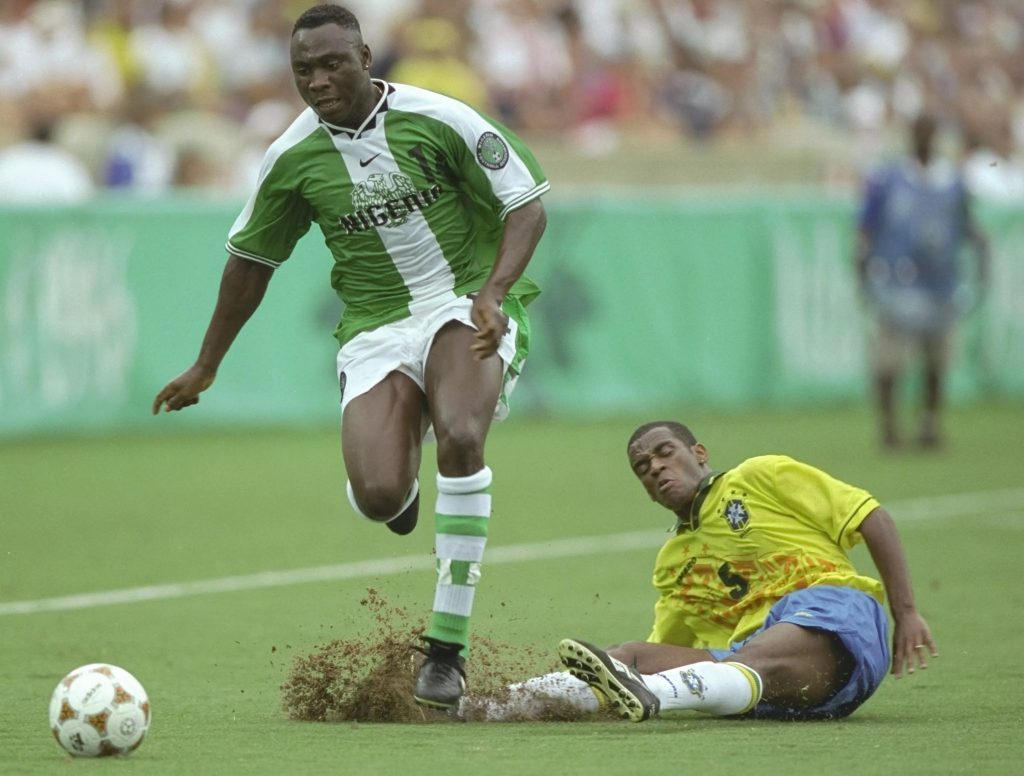
Everton signed him in 1994 for £3 million. He scored twice in the 1995 FA Cup semi-final against Tottenham, then won the FA Cup itself — the first African to win it. He moved to Beşiktaş in Turkey in 1996 for £1.75 million, and later played for Colorado Rapids in the United States. For Nigeria he won 44 caps and scored 13 goals: he was part of the side that won the 1994 Africa Cup of Nations, scored at the 1994 World Cup in the United States, and scored in the final at the Atlanta 1996 Olympics as Nigeria beat Argentina to win gold.
After retiring he went into coaching: Nasarawa United, Enyimba, Ifeanyi Ubah and Lobi Stars, where he stepped down in February 2025, plus a spell with JS Hercules in Finland. He served as assistant coach of the Super Eagles under Shuaibu Amodu and Stephen Keshi — part of the team that won the 2013 Africa Cup of Nations — and was interim coach of the national team in 2014 and 2015. In February 2020, President Muhammadu Buhari appointed him Nigeria’s Football Ambassador. He also runs the Daniel Amokachi Eduplus Youth Development Foundation, combining sports training with education.
Why him: credibility. The committee needs the trust of players, fans and the football public, and Amokachi is the name that carries it — a player and coach who has lived the game from the inside.
5. Amina Yerima — the one nobody knows
The fifth name on FIFA’s letter. Unlike the other four, no public profile or previous football role for her was carried in any of the reporting of the appointments. She is a member of the committee on the same terms as the rest — and the one Nigerians know least about.
What the committee has to do
Run the NFF’s affairs, review its statutes and electoral framework, propose governance reforms, and organise fresh elections for a new executive committee. Its mandate ends when the work is done — and no later than 31 May 2027, with a new elected leadership expected to take office from June 2027.
Two rules come with the job. The five take up their duties immediately, subject to eligibility screening by FIFA’s Review Committee. And none of them will be allowed to contest any position in the elections they organise — the committee is a caretaker, not a campaign. FIFA and CAF have also reserved the right to revoke any member’s mandate, or appoint additional members, at any time.
Why this matters
FIFA does not take over a national federation lightly. A normalisation committee is the last resort, used when a member association is in crisis — and Nigerian football has been in one since August, with no elected leadership at all.
The committee also takes over with the Super Eagles in the middle of their campaigns. The team that carries the country’s hopes will now be run, off the pitch, by five people FIFA picked — a lawyer who has run football elections, a reform expert, a journalist who runs clubs, a former Super Eagle, and one name nobody knows yet.
What we don’t know
- Whether all five clear FIFA’s eligibility screening — their appointments are subject to it.
- When the fresh elections will actually hold, and who will emerge to run the NFF.
- What the committee will change first — and whether it will say anything publicly about the state of the federation it has inherited.
- What happens to the Super Eagles’ campaigns in the meantime.
- Who Amina Yerima is — and what she brings to the committee.
We will update this post when the committee is confirmed, when it speaks, and when an election date is set.
Featured image: Daniel Amokachi in action for Nigeria at the Atlanta 1996 Olympics, via FIFA.