
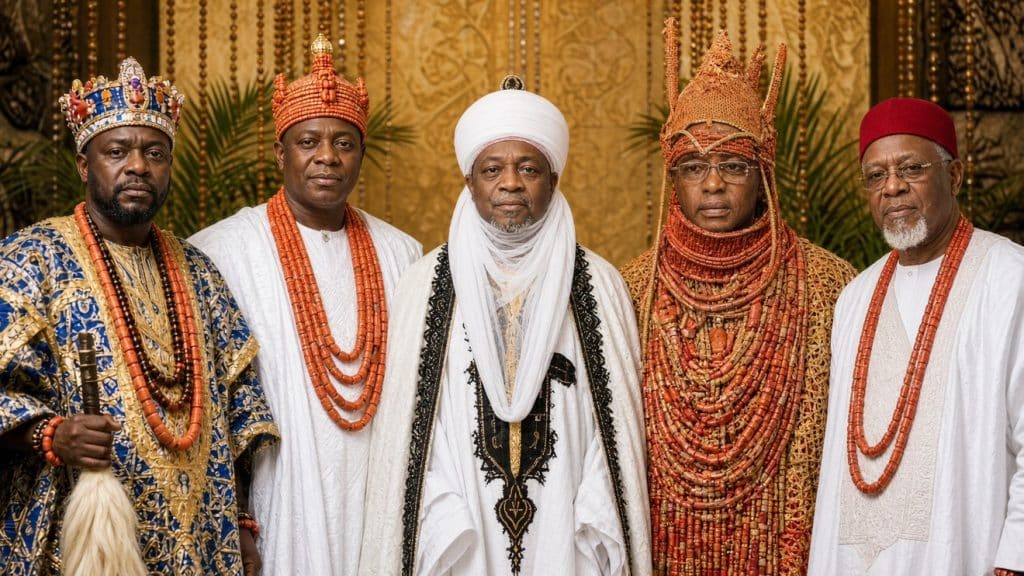
Nigeria has no king of kings. What it has is something older and more interesting: dozens of ancient thrones, each with its own history, its own line of succession, and its own claim to greatness. Some of these monarchs were soldiers, bankers, professors and diplomats before the crown found them. One throne is currently empty. One is claimed by two men. And one new king took over this year after his throne sat empty for nearly three years.
Here are 12 of the most prominent first-class traditional rulers in Nigeria today — who they are, how long they have reigned, and the facts that make each of them worth knowing.
1. The Ooni of Ife — Oba Adeyeye Enitan Ogunwusi, Ojaja II
Throne: Ile-Ife, Osun State. On the throne since: 7 December 2015 — nearly 11 years.
The Ooni sits on what Yoruba tradition regards as the oldest throne in Yorubaland: Ile-Ife is held to be the cradle of the Yoruba people, the city founded by Oduduwa himself. Ogunwusi is the 51st Ooni, and he was 41 when he was crowned — the youngest Ooni in over 600 years.
Before the throne, he was not a career royal. He studied accountancy at The Polytechnic, Ibadan, qualified as a chartered accountant, and built a career in real estate in Lagos. He was selected from the Giesi ruling house on 26 October 2015, after the death of Oba Okunade Sijuwade, and took his oath of office on 7 December that year. He holds the national honour of Commander of the Order of the Federal Republic (CFR), conferred in October 2022, and he is the permanent co-chairman of the National Council of Traditional Rulers, alongside the Sultan of Sokoto.
2. The Oba of Benin — Omo N’Oba N’Edo Uku Akpolokpolo, Ewuare II
Throne: Benin City, Edo State. On the throne since: 20 October 2016 — 10 years, marked in October 2026.
The Benin throne is one of the oldest continuous monarchies in Africa, with a line stretching back to the 12th and 13th centuries. Ewuare II is the 40th Oba, and he chose his name in tribute to Ewuare I, the great 15th-century warrior king who expanded the Benin Empire.
Before he became Oba, Eheneden Erediauwa was a career diplomat — Nigeria’s ambassador to Sweden, with concurrent accreditation to Norway, Denmark and Finland, and later ambassador to Angola and Italy. He succeeded his father, Oba Erediauwa, and was crowned on his own 63rd birthday. In his first decade on the throne he has led the palace’s long campaign for the return of the Benin Bronzes, the thousands of plaques and sculptures looted from the palace by British forces in 1897 — a campaign that has started to bear fruit, with artefacts returning from museums in Europe.
3. The Sultan of Sokoto — Alhaji Muhammadu Sa’ad Abubakar III
Throne: Sokoto. On the throne since: 2 November 2006 — 20 years, marked in November 2026.
The Sultan is the spiritual leader of Nigeria’s Muslims and the head of the Sokoto Caliphate, founded in 1804 by the scholar and reformer Sheikh Usman dan Fodio. Sa’ad Abubakar is the 20th Sultan, and he has now reigned longer than any Sultan this century.
He came to the throne from the army, not the palace. Born on 24 August 1956, the youngest son of Sultan Siddiq Abubakar III, he entered the Nigerian Defence Academy in 1975, served in the Armoured Corps, did peacekeeping duty in Chad, worked with ECOWAS and ECOMOG, and served as Nigeria’s Defence Attaché to Pakistan before retiring as a Brigadier-General in 2006. He was chosen days after his elder brother, Sultan Muhammadu Maccido, died in the ADC Airlines crash of 29 October 2006. He turned 70 in August 2026. As President-General of the Nigerian Supreme Council for Islamic Affairs, he is the highest Islamic religious authority in the country, and as co-chairman of the Nigeria Inter-Religious Council he sits at the centre of Christian-Muslim dialogue.
4. The Emir of Kano — a throne claimed by two men
Throne: Kano. Status: disputed — read this one carefully.
Kano is the one throne on this list that cannot be described with a single name, because two men currently claim it and the courts have not yet settled the matter.
Muhammadu Sanusi II was first made Emir on 8 June 2014, succeeding his great-uncle Ado Bayero, who had reigned for 51 years. Before the throne, Sanusi was Governor of the Central Bank of Nigeria from 2009 to 2014, where he led sweeping banking reforms and was suspended after alleging that $20 billion in oil money was unaccounted for. He is also the Khalifa — spiritual leader — of the Tijjaniyya Sufi order in Nigeria. He was deposed in March 2020 by then-Governor Abdullahi Ganduje.
His successor, Aminu Ado Bayero — son of the long-reigning Ado Bayero — became the 15th Emir in March 2020. In May 2024, Governor Abba Kabir Yusuf repealed the 2019 law that had split Kano into five emirates and reinstated Sanusi. Bayero challenged his removal in court. Today Sanusi occupies the historic Gidan Rumfa palace while Bayero operates from the Nassarawa mini-palace, and the Supreme Court — after a first hearing on 20 April 2026 — has adjourned the case to 19 April 2027. Until it rules, neither man’s claim is final — and this post does not declare a winner.
5. The Alaafin of Oyo — Oba Abimbola Akeem Owoade I
Throne: Oyo town, Oyo State. On the throne since: crowned in April 2025 — the newest king on this list.
The Alaafin was once the ruler of the old Oyo Empire, one of the most powerful states in pre-colonial West Africa. Owoade is the 46th Alaafin, and his arrival ended nearly three years without a king: his predecessor, the legendary Lamidi Adeyemi III, reigned for over five decades before his death in April 2022.
Owoade’s story is the most modern on this list. Born on 17 July 1975, he studied mechanical engineering at the Federal Polytechnic, Ilaro and The Polytechnic, Ibadan, then earned a BSc and an MSc in mechanical engineering in the UK, at the University of Sunderland and Northumbria University. He worked as a planning engineer in Scotland and then in Canada, where he was a project coordinator with Manitoba Hydro and ran a real estate and financial services business. He is a dual citizen of Nigeria and Canada. Governor Seyi Makinde approved his selection on 10 January 2025, and he was presented with the staff of office on 13 January, before his coronation in April.
6. The Obi of Onitsha — Igwe Nnaemeka Alfred Achebe, Agbogidi
Throne: Onitsha, Anambra State. On the throne since: 14 May 2002 — 24 years, the longest unbroken reign on this list after the Sultan.
The Obi of Onitsha leads a monarchy whose line is said to be unbroken for over 500 years, tracing back to Ezechima, the founding monarch of Onitsha Ado N’Idu. Achebe is the 21st Obi, and he ascended the throne on his 61st birthday, after a selection process involving 21 candidates.
His life before the throne reads like a boardroom CV: a chemistry degree from Stanford University, an MBA from Columbia University, and a 24-year career with the Royal Dutch Shell Group, where he rose to director level and served as an ambassador-at-large. He is Chancellor of Ahmadu Bello University, a position he has held since 2015, and he chairs the boards of Unilever Nigeria and International Breweries. He turned 85 in May 2026. His Ofala festival, held every October, is one of the great cultural events of the South-East.
7. The Olu of Warri — Ogiame Atuwatse III
Throne: Warri, Delta State. On the throne since: 21 August 2021 — 5 years, marked in August 2026.
The Warri Kingdom was founded around 1480 by Ginuwa, a prince of Benin, and the Olu’s line has run for more than 500 years — including an extraordinary 88-year stretch, from 1848 to 1936, when the kingdom had no crowned king at all. Atuwatse III is the 21st Olu.
Born Utieyinoritsetsola Emiko on 2 April 1984, he is the son of the 19th Olu, Atuwatse II, and the nephew of his predecessor, Ikenwoli I. He was 37 when he was crowned at Ode-Itsekiri, the ancestral home of the Itsekiri people — the youngest Olu in the kingdom’s history. He studied in the United States, earning a degree in international studies and political science and a master’s in management from Case Western Reserve University. His first act as king made headlines across Nigeria: in his coronation speech, he formally reversed a curse his grandfather, Olu Erejuwa II, had placed on Nigeria decades earlier. The run-up to his coronation was dramatic in its own right — the kingdom’s 400-year-old crown was reported stolen days before the ceremony.
8. The Oba of Lagos — Oba Rilwan Babatunde Osuolale Aremu Akiolu
Throne: Lagos Island, Lagos State. On the throne since: crowned 9 August 2003 — 23 years.
The Oba of Lagos rules from the Iga Idunganran palace on Lagos Island, the historic seat of a monarchy that predates the city itself. Akiolu is the 21st Oba of Lagos.
He was born on 29 October 1943 — he turned 83 in October 2026 — and studied law at the University of Lagos before spending 32 years in the Nigeria Police Force, rising to Assistant Inspector-General of Police in 1999 and retiring in 2002. He was selected by the kingmakers on 23 May 2003, days after the death of his predecessor, Oba Adeyinka Oyekan, and crowned that August. A trained lawyer and a former top policeman, he is one of the most politically influential traditional rulers in the South-West, and the chairman of the Lagos State Council of Obas.
9. The Etsu Nupe — Alhaji Yahaya Abubakar
Throne: Bida, Niger State. On the throne since: 11 September 2003 — 23 years.
The Etsu Nupe is the ruler of all Nupe-speaking people, one of the largest ethnic groups in central Nigeria, and the chairman of the Niger State Council of Traditional Rulers. Abubakar is the 13th Etsu Nupe.
Like the Sultan, he came to the throne from the barracks. Born on 12 September 1952 in Bida, he entered the Nigerian Defence Academy in 1973, served as a director of foreign operations at Defence Headquarters in Abuja, and retired as a Brigadier-General in September 2003 — the same month he was appointed Etsu Nupe, succeeding his late uncle, Umaru Sanda Ndayako. He was awarded the national honour of Commander of the Order of the Federal Republic in 2004, and he chairs the coordinating committee of the National Council of Traditional Rulers.
10. The Shehu of Borno — Alhaji Abubakar Ibn Umar Garbai El-Kanemi
Throne: Maiduguri, Borno State. On the throne since: 2 March 2009 — 17 years.
The Shehu of Borno is the living link to the Kanem-Bornu Empire, one of the great empires of African history, whose roots reach back over a thousand years. El-Kanemi is the 20th Shehu in the line of the al-Kanemi dynasty, founded in the early 19th century by the scholar and military leader Muhammad al-Amin al-Kanemi.
Born on 13 May 1957 in Damagum, in what is now Yobe State, he is the son of Shehu Umar ibn Abubakar Garbai, who ruled from 1968 to 1974. Before the throne he spent a long career in local government administration across Borno State. He was appointed Shehu on 2 March 2009, days after the death of his predecessor, Mustafa ibn Umar el-Kanemi, who had reigned for 34 years, and received the traditional Kanuri investiture — the bayatu — two days later. He has held the throne through the darkest years of the Boko Haram insurgency, remaining in Maiduguri and speaking constantly for peace and for the displaced people of the North-East.
11. The Olubadan of Ibadan — Oba Rashidi Adewolu Ladoja
Throne: Ibadan, Oyo State. On the throne since: 26 September 2025 — just over a year.
The Olubadan’s throne is unlike any other in Nigeria. There is no royal family that owns it: any Ibadan son who becomes a family head joins a promotion ladder of more than 20 stages, on two lines — the civil Otun line and the military Balogun line — and climbs it, step by step, until the throne is his. Ladoja is the 44th Olubadan, and he climbed every rung.
Born on 25 September 1944, he was a senator and then Governor of Oyo State from 2003 to 2007, and a businessman, long before the crown. He was crowned at the historic Mapo Hall on 26 September 2025 — a day after his 81st birthday — succeeding Oba Owolabi Olakulehin, the 43rd Olubadan, who died in July 2025. President Bola Tinubu attended the coronation. He marked his first anniversary on the throne in September 2026, and in April 2026 he inaugurated the Ibadan Community Guards, a local security outfit for the city.
12. The Tor Tiv — Professor James Ortese Iorzua Ayatse, Tor Tiv V
Throne: Gboko, Benue State. On the throne since: 4 March 2017 — nearly 9 years.
The Tor Tiv is the paramount ruler of the Tiv people, one of the largest ethnic groups in Nigeria, and the chairman of the Benue State Council of Chiefs. The institution itself is young by Nigerian royal standards — the first Tor Tiv was installed in 1946 — but Ayatse is its most unusual occupant.
Born on 12 May 1956, he is a professor of biochemistry who became a professor at 37, and the first Tiv man to serve as vice-chancellor of two federal universities: the University of Agriculture, Makurdi (2001–2006) and the Federal University, Dutsin-Ma, where he was pioneer vice-chancellor (2011–2016). He is also the first professor ever to rule as Tor Tiv. He was elected by the Tiv Supreme Council on 20 December 2016, polling 39 of 46 votes against three other contenders, and crowned at Gboko on 4 March 2017. Breaking with tradition, he took his oath of office on the Christian Bible rather than the ancestral Swem.
One throne is empty: the Awujale of Ijebuland
No list of Nigeria’s top monarchs is complete without noting the one great throne that currently has no king. Oba Sikiru Kayode Adetona, the Awujale of Ijebuland, died on 13 July 2025 at the age of 91, after 65 years on the throne — one of the longest reigns of any Nigerian monarch. More than a year later, the stool is still vacant: the succession rotates among four ruling houses, it is the Fusengbuwa house’s turn, 95 aspirants came forward, and the process has stalled amid family disputes, legal challenges and government intervention. Governor Dapo Abiodun has promised a new Awujale will emerge before 29 May 2027. Until then, Ijebuland waits.