
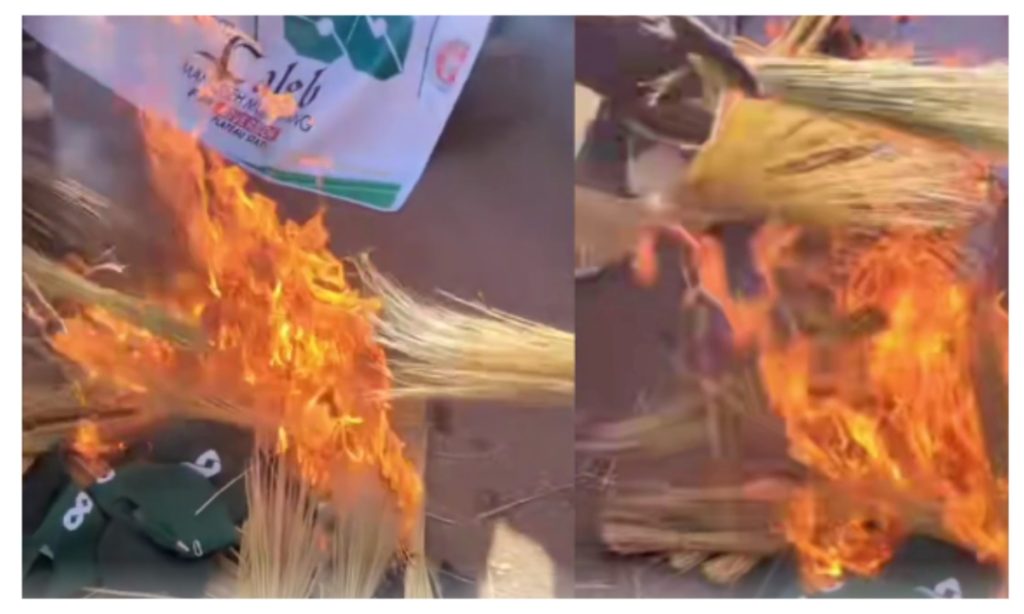
On Saturday in Jos, residents took the caps and brooms handed out at President Bola Tinubu’s own campaign rally and set them on fire. “We are hungry. We don’t need caps and brooms. We need food, jobs and security.”
It was the most visual rejection yet. But it was not the first. In the space of four weeks, Nigerians have said no to the president’s face five times — at his campaign flag-off, in two mosques, at Friday prayers in Abuja, and at a rally in Jos. Three of the five times, the crowd used the same two words: “Ba ma yi.” Hausa for “we don’t want you.”
Here are all five.
1. Jos, Plateau — they burned his caps and brooms
The latest happened on Saturday 14 November, at the APC North-Central presidential campaign rally at Zaria Road Stadium in Jos. The rally began at 10:00 in the morning, with Vice President Kashim Shettima, First Lady Oluremi Tinubu, Senate President Godswill Akpabio, Speaker Tajudeen Abbas and APC National Chairman Nentawe Yilwatda all in attendance.
Tinubu used the rally to apologise to Plateau residents. On his last visit to the state, in April, he had been limited to the airport after the attack on Angwan Rukuba community on 29 March, in which at least 27 people were killed. “When I last visited the other time, I was limited to the airport,” he said. “Forgive me if you didn’t see me in the hinterland, but I saw the devastation. I got the report from the governor. I saw horror in the faces of our people.” He pledged federal support to rebuild communities hit by insurgency and help displaced residents return home. Plateau had more than 45,000 internally displaced people as of August, according to the UN refugee agency.
The apology was delivered inside the stadium. Outside it, the reception was very different. As the president’s convoy passed through Jos, a section of residents behind barricades booed and chanted “Ba ma yi”, some turning their backs and waving their hands. Security operatives moved in to control the crowd, while APC supporters tried to drown out the chants with songs.
Then came the burning. After the rally, some residents gathered the crested caps and brooms distributed at the event and set them ablaze, saying they were hungry and wanted food, jobs and security instead. Some reports said planks and sticks were thrown at the convoy. That part has not been independently confirmed, and the Presidency has issued no statement specifically addressing the Jos incident.
2. Abuja mosque — “Ba mayi” as his convoy left
The day before Jos, on Friday 13 November, Tinubu attended Juma’at prayers at the Shehu Shagari Central Mosque in Area 1, Garki, Abuja. He arrived at about 1:49pm, by which time access to the mosque had already been restricted. Roads were blocked, and worshippers were prevented from leaving until the president departed.
As his convoy left, video clips obtained by Premium Times showed people chanting against him — “Ba mayi, ba ma so”, a Hausa expression meaning “we are not supporting you”, and “Tinubu Must Go”. Eyewitnesses said the booing started from the area where people had been barricaded, and some linked the anger to the security restrictions imposed because of the visit.
Some videos and reports said stones were thrown at the convoy. That claim has not been verified. A ThisDay fact check found no independently verified evidence that the president was personally hit by a stone or sustained any injuries, and rated the claim that he was stoned as false.
The Presidency pushed back hard. O’tega Ogra, the president’s senior aide on digital media, posted footage of Tinubu leaving the mosque and called the circulating reports misleading. “Contrary to the narrative being pushed by the opposition, with videos of their alleged paid thugs at the Mosque today, here is footage of Mr President leaving the mosque after Friday prayers this afternoon,” he wrote. “FACT CHECK: The opposition lied.” Presidential spokesman Bayo Onanuga also dismissed the claim, telling Peoples Gazette: “This is not true.” A group of FCT residents later claimed the protest was staged and that protesters had been brought in from other states — a counter-claim that has itself not been verified.
The mosque incident came on the same day the president warned politicians and their supporters against political violence ahead of the 2027 general elections.
3. Jalingo, Taraba — the walkout
Two weeks earlier, on Friday 30 October, worshippers walked out of a mosque in Jalingo, the Taraba State capital, during Juma’at prayers. The cleric, Sheikh Ibrahim Jalo Jalingo — the mosque’s Chief Imam and National Chairman of the Council of Ulama of JIBWIS Nigeria — had declared that Tinubu’s government was not oppressive and urged the congregation to support the president’s re-election in 2027.
A worshipper immediately challenged him, shouting “That’s a lie!” A video recorded inside the mosque showed worshippers leaving their prayer mats and walking out as the disagreement unfolded. How many left, and whether the prayers were disrupted, could not be independently confirmed, and neither the mosque committee nor the sheikh issued an official statement about the walkout at the time. The following morning, Jalingo posted on Facebook urging Taraba residents to be patient and support the APC in the coming elections.
4. Kaduna — the flag-off that started it
The pattern began at the event that was supposed to launch the campaign. On Saturday 24 October, Tinubu was in Kaduna for the flag-off of his 2027 presidential campaign at Ranchers Bees Stadium, where thousands of supporters had gathered from the seven North-West states.
He arrived five hours late. When he took the podium and shouted “Nigeria”, a section of the crowd answered “Ba ma yi”. When he said “Kaduna”, they answered differently again — so much so that he had to say “Sai Uba Sani”, the name of the Kaduna governor, himself before he could continue his speech.
Daily Trust, which first reported the chants, said some of those who booed cited insecurity and the government’s harsh economic policies as their reasons. Yushau Adamu, the paper’s Regional Editor, later confirmed on Trust TV that the chants disrupted the president’s speech. Security was tightened when Tinubu left the venue, and people were chased away from the main road to the airport — apparently in anticipation that the chanting would resume as he passed.
5. Bauchi — the mosque that sacked its imam
The earliest of the five happened on Sunday 18 October, at Masjid Abdullahi Bin Zubbair in Madina Quarters, Bauchi. The mosque’s management committee removed its imam, Dahiru Abubakar, after repeated warnings that he was using his sermons to campaign for Tinubu’s re-election — defending the administration against criticism over insecurity and economic hardship and urging worshippers to give the president another term.
Abubakar had also proposed renaming the mosque after the president, to Masjid Imam Bola Ahmed Tinubu. The committee rejected the proposal outright, insisting the mosque belonged to the community and could not be renamed to honour a political figure. The committee’s chairman, Imam Abubakar Jibrin, confirmed the removal and said there were no plans to reinstate him — but he also said the decision was about keeping politics out of the mosque, not about Tinubu himself. The committee maintained it had not taken a position for or against any candidate.
Even with that caveat, the message was plain: a mosque in the north refused to be a campaign platform for the president’s re-election, and refused to carry his name.
What the pattern says
Five rejections in four weeks, all of them in the north, all of them in public, and three of them using the same chant. The complaints are the same each time: hunger, insecurity, and the economy. In Kaduna, the crowd cited insecurity and economic policies. In Jos, the chant was “we are hungry” and “we need food, jobs and security”. In Jalingo, the argument was over whether the government is oppressive. In Bauchi, the imam was sacked for telling worshippers to stop blaming the president for insecurity and hardship.
The Presidency’s responses have followed their own pattern: deny, dismiss the videos as misleading, blame the opposition. It denied the mosque attack, called the footage misleading, and suggested paid thugs were involved. It has not commented on Jos at all.
With the presidential election scheduled for Saturday 16 January 2027, every public appearance by the president is now a campaign event — whether he wants it to be or not. The crowds are treating it that way. And in the last four weeks, they have answered him the same way, in the same words, in five different places.
Featured image: Still from the video of Plateau residents burning APC caps and brooms in Jos, via Daily Post.