
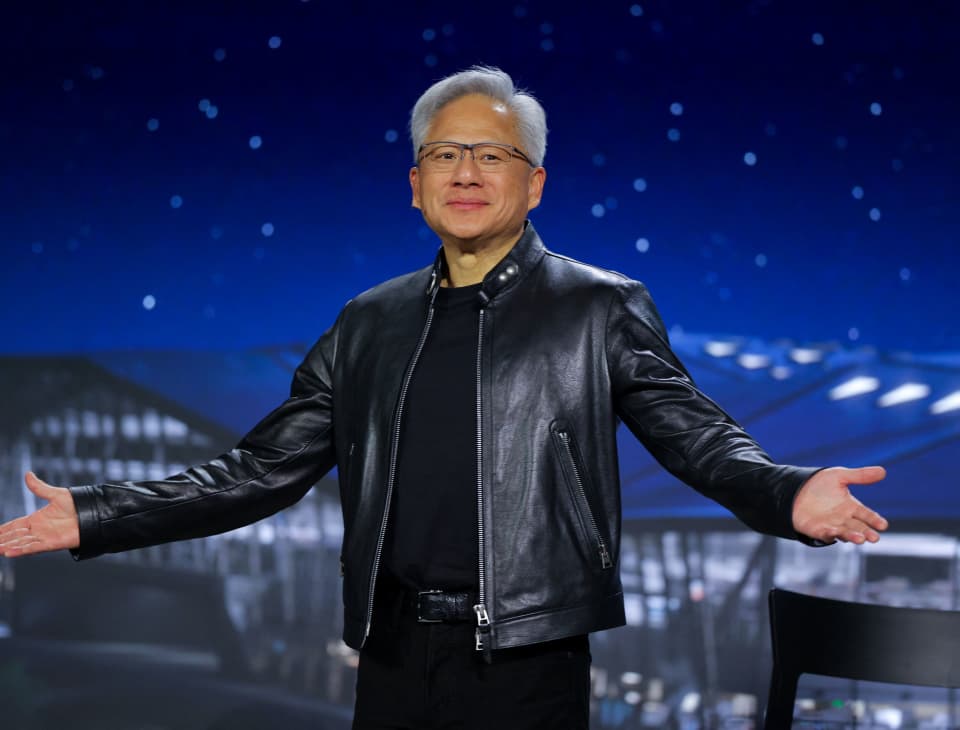
In one week, the most valuable company on earth lost its founder, its chief executive and more than $1 trillion in market value. Jensen Huang built Nvidia from a graphics-chip startup into the company at the centre of the artificial intelligence boom, and he ran it for 33 years. On Thursday, he resigned. The shares had already been falling for days. Then they fell off a cliff.
This is what the numbers actually say.
The week in numbers
Nvidia’s shares hit an all-time high of $243.37 on 6 October. By the close of trading on Monday 3 November, they were at $206.69. Then the slide turned into a rout: down 9.3% in a single day on 5 November to $181.60, down again on 9 and 10 November, and a small bounce on Wednesday 11 November to $173.73. After the market closed that evening, the shares fell another 8.6% to $158.76. Before the market opened on Thursday they were down more than 10% at around $156. They opened at $151.01, touched a low of $148.80, and had recovered to about $165 by midday.
From the 3 November close to the pre-market low, the fall was about 24.5%. From the October peak to Thursday’s low, it was almost 38%.
How it happened, day by day
The trouble started in late October, when reports emerged of Huang’s close relationship with a former executive at a Singapore-based company, a woman US intelligence officials reportedly identified as a Chinese intelligence asset suspected of passing information to Beijing.
On Sunday 8 November, Nvidia’s board opened an independent investigation, run by outside lawyers and a former federal prosecutor, while publicly expressing confidence in Huang. The board said it had no reason to believe national security or Nvidia’s secrets had been compromised.
Two days later, an investigation alleged that intermediary networks linked to that same Singapore company had routed around 240,000 banned Nvidia AI chips, worth about $7.5 billion, into China over three years.
On Wednesday 11 November, reports emerged of a second alleged affair, this time with a senior Nvidia executive who reported directly to Huang. That evening, reports said the board was preparing to remove him and was meeting to decide his future. The board accepted his resignation that night.
On Thursday morning, the company announced it: Huang had resigned as president, chief executive and a member of the board, effective immediately. The announcement gave no reason. It thanked him for his 33 years.
The night the market moved first
The market did not wait for the announcement. The shares fell 8.6% in after-hours trading on Wednesday evening, as soon as reports said the board was preparing to remove Huang. By Thursday morning, before the opening bell, they were down more than 10%.
At the open, the shares traded as low as $148.80 — a level not seen in more than a year. They recovered through the morning to around $165 by midday, still down about 5% on the day. The recovery tells its own story: investors are not selling because the business is broken. They are selling because they do not know who runs it next.
More than $1 trillion gone
Nvidia was worth about $4.19 trillion at Wednesday’s close. From the 3 November close to Thursday’s pre-market low, the company lost more than $1 trillion in market value. In the three trading days after the board opened its investigation, about $300 billion disappeared. From the October peak to Thursday’s low, the loss is more than $2 trillion.
At Thursday’s pre-market price, the company’s value was on course to drop below $4 trillion for the first time since July 2025.
The $7.5 billion question hanging over the shares
The personal scandal is only half the story. The other half is about chips, China and American export law.
The United States has banned the sale of Nvidia’s most advanced AI chips to China since 2022. The investigation alleged that around 240,000 of those banned chips, mostly the H100 and H200 models that power the biggest AI systems, reached China anyway through a network of intermediaries, worth about $7.5 billion in total.
The claims have not been verified by a government agency. But the US Commerce Department has been investigating one of the companies in the network since late 2024, and lawmakers from both parties are now pushing for tougher export controls to be written into law, with a vote expected in December.
For investors, that is a second risk on top of the leadership question: not just who runs Nvidia, but whether Washington is about to tighten the rules on its biggest market.
What Wall Street is saying
One prominent tech analyst put a price on Huang himself: the shares are worth $300 with him as chief executive and $225 without him — a quarter of the company’s value, resting on one man. He kept his buy rating and his $300 target, but only while Huang stayed.
Others moved faster. One bank downgraded the stock, citing the likely departure and the scrutiny around it as a significant overhang. Two more cut their price targets, to $225 and $205. But the defenders are still there: one research firm kept its $310 fair-value estimate, another kept its $300 target, and a third kept its strong-buy rating with a $515 target.
The consensus is still a strong buy, with an average target around $311 — far above where the shares are trading. The message from Wall Street is consistent: the business is intact, the leadership is the problem.
The short sellers are having the week of their lives
While long-term holders watched more than $1 trillion evaporate, the people betting against Nvidia made billions. Short sellers were sitting on about $3.8 billion in paper profits at Wednesday’s close. At a share price of $163, those gains would swell to about $6.8 billion.
Nvidia now trades at about 12 times its expected earnings over the next year — its lowest valuation on that measure since 2012. For a company that was the face of the AI boom, that is a remarkable comedown.
Why one man was worth $75 a share
Huang co-founded Nvidia in 1993 and ran it for 33 years. He is not just the chief executive — he is the person who bet the company on AI when it was still a graphics-chip maker, and he is the face of the company to customers, governments and investors.
That is why the market reacted the way it did. This was not a bad quarter or a missed product launch. It was the sudden removal of the one person the market believed could not be replaced, with no successor named and no plan in public.
The interim chief executive is Colette Kress, the chief financial officer since 2013, who keeps the finance job while the board searches for a permanent successor. The board has also appointed its first-ever chair, longtime director Harvey C. Jones. The search will consider internal and external candidates. Nobody knows how long it will take.
What happens next
The next fixed date is Tuesday 17 November, when Nvidia reports its third-quarter results. The market expects earnings of about $2.53 a share on revenue of about $111.4 billion. It will be the company’s first results under an interim chief executive, and the first since the investigation began.
The independent investigation is still running, and no findings have been announced. The company has not said whether it will continue now that Huang has left.
In Washington, the push for tougher chip export controls is moving toward a vote in December. And the board’s search for a permanent chief executive has only just begun.
What it means for the AI rally
The wider market wobbled but did not collapse. The Nasdaq 100 slipped about 1% in futures trading on Thursday, a day after jumping 2.28%. Other AI-linked stocks fell around the world, but the selling was concentrated where the news was: Nvidia.
The AI boom is not over. Demand for the chips has not changed, the order books have not changed, and the technology has not changed. What changed is the belief that one man was indispensable to it. The market has now put a price on that belief: about $75 a share, and more than $1 trillion in a week.
Featured image: Reuters.