
Nigeria vs Japan: 7 things to know before the U-17 World Cup final
Nigeria’s Flamingos are one win away from a world title. On Saturday night in Rabat, they face Japan in the final of the FIFA U-17 Women’s World Cup — the first time Nigeria has ever reached this final, and the first time any African team has.
Here are seven things to know before kick-off.
1. The final is on Saturday night — and it is a date with history
The final is on Saturday 7 November 2026, with kick-off at 19:30 WAT in Rabat, Morocco. Nigeria against Japan, for the trophy. Win, and the Flamingos become world champions for the first time — and the first African champions in the history of the tournament. Lose, and they still come home as finalists, which no African team has ever managed before. Either way, Saturday night is already historic. But nobody in that dressing room is thinking about second place.
2. They got here the hard way — five straight wins after losing the first game
Nigeria lost their opening group game 2-1 to Poland, and have not lost since. They beat Puerto Rico 2-0, then beat the defending champions, North Korea, 3-1 to get out of the group. In the knockouts they beat Mexico 2-1, edged Venezuela 1-0 in the quarter-final thanks to a late penalty from captain Azeezat Oduntan, and then beat Brazil 3-1 in the semi-final. Five wins in a row, against the champions, against Brazil, against everybody the draw threw at them. This is not a lucky run. It is a team that keeps finding a way.
3. The Brazil game was the best night of the tournament so far
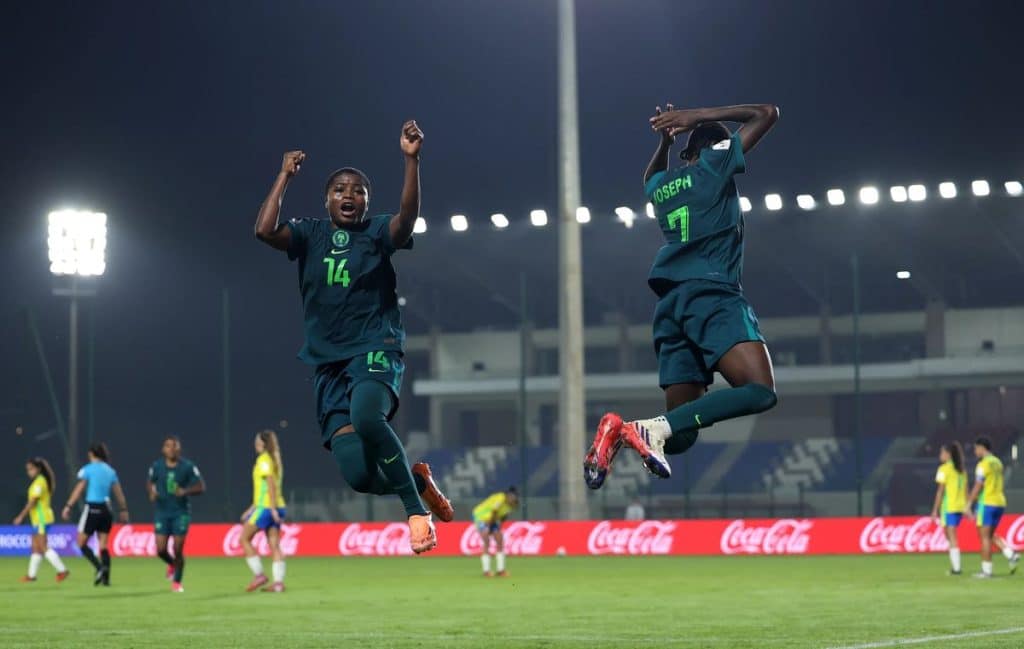
Wednesday’s semi-final was goalless at half-time, and then the Flamingos took over. Queen Joseph broke the deadlock in the 56th minute, Awawu Bashiru doubled the lead in the 71st minute, and Bashiru struck again in the 80th to make it 3-0. Brazil pulled one back in the 89th minute, but it was only a consolation. Bashiru was named player of the match, and the 3-1 win sent Nigeria into their first ever final. The second half in Rabat was the Flamingos at their best: fast, direct, and ruthless when the chances came.

4. Japan are not here by accident — they knocked out the champions too
Japan’s route to the final is just as impressive. They won all their group games, beating Zambia, France, Venezuela and Kenya, then beat Ghana 1-0 in the quarter-final. In the semi-final they faced North Korea, the two-time defending champions, and did what nobody else could: they came from behind, forced a 1-1 draw with a stoppage-time own goal, and then won the penalty shootout 4-1. Japan are former champions — they won this tournament in 2014 and were runners-up in 2010 and 2016 — and they have not lost a game in Morocco. They are organised, patient, and very hard to break down. This final is a proper contest, not a formality.

5. The coach has been here before — just not as the man in charge
Head coach Akeem Busari has been around Nigerian youth football for a long time. He was an assistant coach when Nigeria’s Golden Eaglets won the U-17 World Cup in 2007, and now, almost twenty years on, he is the head coach taking a Nigerian team to a world final of his own. After the Brazil win he was clear about what comes next: the trophy is the major thing the country wants, and the job now is to fight to win it. He has also just been appointed coach of Remo Stars Ladies, but on Saturday night, only one job matters.
6. The players to watch: Joseph, Bashiru, and the captain
Queen Joseph and Awawu Bashiru are the names to know. Joseph opened the scoring against Brazil, Bashiru scored twice and was player of the match, and the two of them have been involved in most of Nigeria’s best moments in Morocco. Captain Azeezat Oduntan scored the late penalty that beat Venezuela in the quarter-final, and Oluwakemi Adegbuyi and Oluebube Umejiaku have set up goals all tournament. For Japan, watch goalkeeper Kou Kadowaki, who saved a penalty in the shootout against North Korea, Asuka Tanaka, who scored the decisive penalty, and Mashiro Yamaji, who was player of the match in that semi-final. Finals are often decided by one moment. These are the players most likely to produce it.
7. What happens on Saturday — and how to watch
It is a double-header in Rabat. Brazil and North Korea play the third-place match earlier on Saturday, at 16:00 WAT, and then Japan against Nigeria at 19:30 WAT. The final is available to stream free on FIFA+ and on FIFA’s YouTube channel, which have carried the tournament live. Check the FIFA+ app or FIFA’s YouTube channel on the day for the stream. If the Flamingos win, they come home as world champions and as the first African team ever to lift this trophy. If you have followed this team at all, you know what Saturday night means. Set the time, tell your people, and watch it live.
